The Tibetan Government in Exile has embarked on a journey which aims to transform agricultural lands in Tibetan Refugee Settlements in India to organic, sustainable farming systems.
In January 2003, Jonathan Halpern, an environmental/social activist fron northern NSW met Venerable Professor Samdhong Rinpoche, Prime Minister of the Tibetan Government in Exile, while at the Asian Social Forum in Hyderabad. Professor Rinpoche welcomed Jonathan’s support in aiding his government on its quest to go organic.
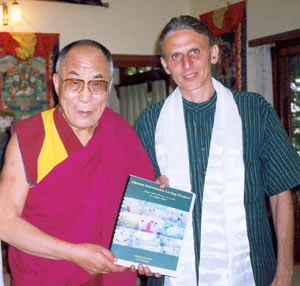
The Dalai Lama with Jonathan Halpern
To support this vision, a Permaculture Design Course was conducted for Tibetan Settlement heads and Agriculture Extension Officers in August 2003, in South India. This course was led by permaculture teacher John Button, originally from northern NSW but now living in Italy.
The course was funded by the Tibetan Government in Exile and Lismore’s Rainforest Information Centre with books, magazines and organic seeds for the course donated by Byron Bay’s Seed Savers Network and Permaculture International Limited, Nimbin.
The first five days of the course were held in Auroville where participants were exposed to many successful experiments of sustainable agriculture and holistic living. The remaining 10 days of the course were held in Bylakuppe, a large Tibetan Refugee Settlement in the state of Karnataka. Here the course was held on an 80-acre experimental farm called the Tibetan Farm Project which has already been organic for a year.
On the journey from Auroville to Bylakuppe, the group visited the Permaculture Demonstration Farm in Tiruvanamalai, a project initiated by the Rainforest Information Centre over a decade ago. It had originally been planned to hold part of the course here, but this was prevented by drought conditions.
The course was an intensive 2 week programme, covering many academic and practical subjects, such as the principles of ecology, methods/limitations of design, soil, climate, water, community and economy, disaster management, creative problem solving, integrated pest/weed management, composting, seed saving and much more.
John and Jonathan remained in Bylakuppe after the course to design the Tibetan Farm Project as an education centre, permaculture demonstration farm, seed production and seed saving centre and nursery.
This course was a preliminary step in the journey of supporting the Tibetan Government in Exile, and the Tibetan people. The project in its entirety involves the conversion to organic of some 27,000 acres of agricultural land in India which is presently predominantly under the cultivation of intensive monocultures of cotton, maize, paddy and sugar cane and this will affect the lives of approximately 80,000 people.
One important aspect of this project is to create a Tibetan Seed Bank, the goal of which is to preserve the indigenous seed varieties of the Tibetan plateau which are currently under serious threat of extinction under Chinese occupation. Seed Savers Network, Byron Bay have pledged their support for this.
It was stressed to the participants of the course that this project was not about putting deeper roots in exile, but rather about learning techniques of earth repair and sustainable farming that will not only benefit them in exile, but will empower them for the time that they may return to a free Tibet and be faced with the monumental task of repairing the ecological damage left by the Chinese.